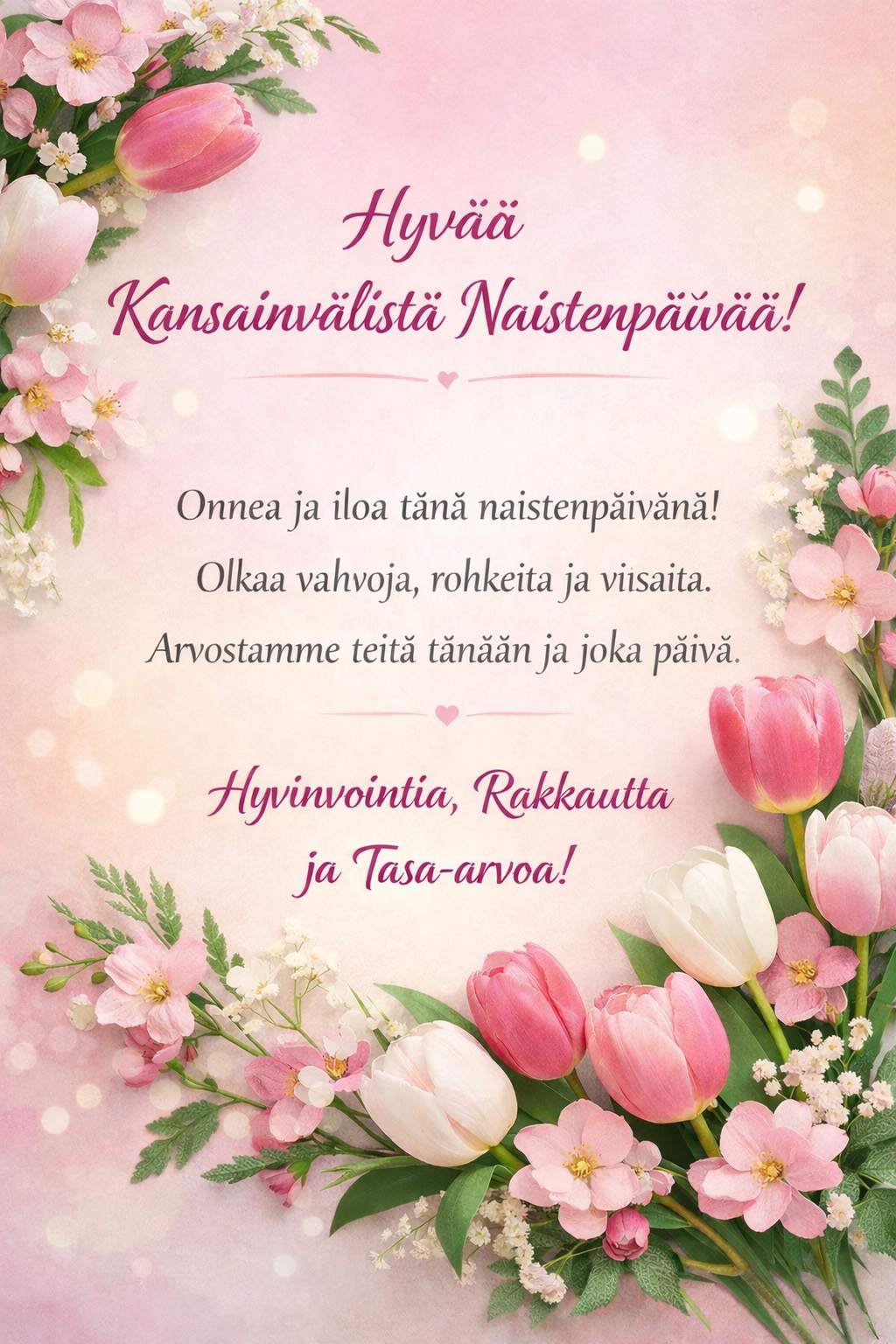
March 8
International Women’s Day – March 8:
History, Traditions in Finland and
the Song “Kokonainen nainen”
International Women’s Day (March 8) is a global day dedicated to women’s rights, gender equality, and recognition of women’s social, economic, cultural, and political achievements. Celebrated worldwide, this date has deep historical roots in the labor movement and the struggle for women’s suffrage.
International Women’s Day in Finland
In Finland, March 8 is not an official public holiday. It is a regular working day, and national flags are not typically raised. However, the day is widely recognized and respected.
Common traditions in Finland include:
- Giving flowers (especially tulips — sales peak on March 8)
- Organizing events focused on gender equality
- Public discussions with women members of parliament
- Seminars and campaigns supporting women’s rights
Finland has historically been a pioneer in gender equality. The country was among the first in Europe to grant women both the right to vote and to stand for election.
The History of International Women’s Day
Origins in the United States
The first National Woman’s Day was observed in 1909 in the United States, organized by the Socialist Party of America. It honored a garment workers’ strike that had taken place in New York City the previous year.
More than 15,000 women marched demanding:
- Shorter working hours
- Better pay
- Voting rights
These protests laid the groundwork for an international movement.
The International Initiative
The idea of creating an international women’s day was proposed by German activist Clara Zetkin in 1910 at the Socialist International conference in Copenhagen.
Among the notable participants were:
- Alexandra Kollontai
- Angelica Balabanoff
- Miina Sillanpää — later the first female minister of independent Finland
The proposal was unanimously approved.
First Official Celebrations
International Women’s Day was first celebrated in 1911 in:
- Austria
- Denmark
- Germany
- Switzerland
Finland began observing the day in 1914.
Why March 8?
The date is connected to events during the 1917 Russian Revolution, when women protested under the slogan «Bread and Peace.» These demonstrations began on February 23 (Julian calendar), which corresponds to March 8 in the Gregorian calendar used today.
In 1975, the United Nations officially recognized March 8 as International Women’s Day.
Today, marches, conferences, educational programs, and awareness campaigns take place around the world to promote gender equality.
The Song «Kokonainen nainen» — «A Whole Woman»
Dear women and girls, I congratulate you on International Women's Day! And as a gift, I want to share with you my favorite song about women. A meaningful musical tribute to women is the song «Kokonainen nainen» («A Whole Woman») performed by Finnish singer Laura Voutilainen. The Finnish title literally translates as «A Complete Woman» or «A Whole Woman.»
| Finnish Оригинальный текст | English Translation |
Kokonainen nainen | A Whole Woman |
|
Mistä kokonaiset naiset on tehny? Liemissä monissa keitetty, pesty? Mausteisista marjoista vai mistä, on suola makeaa, ei pelkkää unelmaa |
What are whole women made of? In how many broths have they been boiled and cleansed? From spicy berries — or from what? There is salt and sweetness, not just a dream. |
|
Kun huuliin punaisiin hän kiiltoa laittaa, ne sävyin syvemmin valoa taittaa. Yhdentoista sentin korot sen kertoo on niiden mittainen, hän kuinka kantaa sen? |
When she adds shine to her red lips, The shades reflect the light more deeply. Eleven-centimeter heels reveal How well she carries herself. |
|
Lujan lempeä, varmaan hempeä, sydäntä jä järkeä avoimen salaperäinen on kokonainen nainen. Sovelias ja siveetön, hallitusti hillitön, tunnollinen, kevytmielinen on kokonainen nainen - kokonainen. |
Strong yet gentle, surely tender, With heart and reason, Open yet mysterious — she is a whole woman. Proper and shameless, controlled yet wild, Responsible yet lighthearted — She is a whole woman — complete. |
|
Huolta vailla vastuunsa kantaa, itsetunnostaan muille myös antaa, miehen käsivarsiin todella luottaa on mies sen arvoinen ja hänkin tietää sen. |
Without worry, she carries her responsibilities, She shares her self-confidence with others, She truly trusts a man If he is worthy — and she knows it. |
Lauluntekijät: Laura Voutilainen / Maki Kolehmainen / Tracy William Lipp
Meaning of the Song
The lyrics emphasize the multidimensional nature of womanhood — strength combined with softness, intellect with emotion, discipline with freedom. It reflects the concept of inner wholeness rather than stereotypical perfection.
Conclusion
International Women’s Day is more than flowers and congratulations. It is a day of remembrance, advocacy, and reflection — honoring the struggle for equality and celebrating women’s achievements worldwide.
May this day bring recognition, respect, health, happiness, and empowerment to women everywhere.
Dear women, I wish you HAPPINESS and LOVE! ❤️